The 1974 film Blazing Saddles is considered one of the great American comedies. A satire not only of movie westerns, but also of American popular culture, many of the movie's scenes have become classic.
One of those highlights was the late Madeline Kahn's performance of "I'm Tired" a comic lament to over-abundant but largely unfulfilling opportunities: "I'm tired of being admired..." We should all have such problems.
The song came to mind this week during discussions with business leaders about coping with the endless series of decisions they must make to keep their organizations moving forward. Being fatigued was a common complaint.
Indeed. We've all had those days where we have felt so bombarded by incoming requests that by day's end we feel paralyzed or simply unable to process even a simple request like: "Honey, what do you want for dinner?" without risking a domestic violence charge.
A blog for those who lead organizations and are seeking to make them better: more profitable, more efficient, more enjoyable. We may be the backbone of the US economy, but sometimes we all need a little tough love.
Monday, February 18, 2013
Monday, February 11, 2013
Who loves ya, baby?
Dear John,
I know that we’ve never paid much attention to the Valentine’s Day thing – it’s not like it’s a legal holiday and all – but I couldn’t let it pass without saying how much better things are between us. What a difference a year makes!
Last winter, I thought we were on the rocks, heading towards being done. You weren't yourself and it seemed like you were just going through the motions.
You had been caring, upbeat, positive, full of ideas. We were a hot item. Everyone talked about us. You were proud. You loved every aspect of running your business.
I know that the never-ending "recession" wore you down. I could see it in the little things, those small gestures that showed that you cared: studying the day’s orders to get a feel for what who was buying what: you could spot changes before they became a trend; “buddying” up with a new employee to get them up to speed, then staying late to catch up on your own work; going to Chamber events and coming back with orders, not just a few business cards that you threw into a pile. I was worried, and I know you were too, though you didn't speak about it.
I know that we’ve never paid much attention to the Valentine’s Day thing – it’s not like it’s a legal holiday and all – but I couldn’t let it pass without saying how much better things are between us. What a difference a year makes!
Last winter, I thought we were on the rocks, heading towards being done. You weren't yourself and it seemed like you were just going through the motions. You had been caring, upbeat, positive, full of ideas. We were a hot item. Everyone talked about us. You were proud. You loved every aspect of running your business.
I know that the never-ending "recession" wore you down. I could see it in the little things, those small gestures that showed that you cared: studying the day’s orders to get a feel for what who was buying what: you could spot changes before they became a trend; “buddying” up with a new employee to get them up to speed, then staying late to catch up on your own work; going to Chamber events and coming back with orders, not just a few business cards that you threw into a pile. I was worried, and I know you were too, though you didn't speak about it.
Monday, February 4, 2013
Deja vu all over again
Two great American pastimes intersected this past weekend: weather prognostication and football, in the forms of Groundhog Day and Super Bowl Sunday.
Both are now spectacles that have evolved far beyond their humble beginnings. Regarding the Super Bowl, I am always awed by the sheer magnitude of this often-not-so-special event. Some big facts about the 2013 Super Bowl:
Groundhog Day is a less over-the-top affair, even in Punxsutawney, and whatever the predicted outcome. Whether early spring or more weeks of winter, February 2nd heralds repeated opportunities to catch one of my favorite movies, Groundhog Day. It's a classic American business morality tale.
Both are now spectacles that have evolved far beyond their humble beginnings. Regarding the Super Bowl, I am always awed by the sheer magnitude of this often-not-so-special event. Some big facts about the 2013 Super Bowl:
- 7.5 million TVs will be bought for the game.
- Nearly $4 million will be spent per 30-second ad during the game.
- 1.2 billion chicken wings will be consumed and 50 million cases of beer will be quaffed.
- 2 billion gallons of water will be used to flush those wings and beer away.
- 7 million people will call in sick on Monday
Groundhog Day is a less over-the-top affair, even in Punxsutawney, and whatever the predicted outcome. Whether early spring or more weeks of winter, February 2nd heralds repeated opportunities to catch one of my favorite movies, Groundhog Day. It's a classic American business morality tale.
Monday, January 28, 2013
Going for it
The debate over "big play" versus "march down the field" has raged for eons...in and out of sporting arenas. Think tortoise v. hare, a fable from Aesop and ancient Greece.
It's true that sluggers are traditionally more revered by fans and big-armed quarterbacks capture more imagination than a great cover corner back. We have home run derbies at the All Star game, not doubles up the gap contests.
But do the bombers win more? Do they contribute more to success than well-rounded excellence? Not according to some. The book and film Moneyball, which is about management as much as it is about baseball, is a recent contributor to this debate. In the world of big business, the go-for-broke and grind-it-out camps each have visible success stories.
Monday, January 21, 2013
Is grease the word?
"I hate to be a kicker,I always long for peace,
But the wheel that does the squeaking,
Is the one that gets the grease."
-- Josh Billings, "The Kicker," ca. 1870
I'm sure that most of you are familiar with the "squeaky wheel" adage, the origin of which is credited to the poem above. Josh Billings was a 19th century American humorist, second in popularity in his time only to Mark Twain.
For business owners, the Squeaky Wheel syndrome is no laughing matter. You want happy customers, not disgruntled ones. Organizations go great lengths and invest great sums to ensure that their organizations not only understand best practices but execute them flawlessly. Some succeed, some don't: There are both customer service Halls of Fame and Halls of Shame.
In a recent discussion about the book Raving Fans, a bestseller about how to make great service a competitive advantage, business owners discussed how they instilled and practiced the "customer first" mentality in their companies.
One retailer described how he sends notes and small gifts to customers who have had issues, whether real or imagined. Asked if she did this for all unhappy customers, she replied "no," but more often than not. Then she was asked what she sends her "best" customers...the ones who buy most frequently, spend the most, are most active on the company's social media pages. After some uncomfortable, but thoughtful silence, the answer was, "nothing, but that will now change."
Squeaky wheels surely need attention. But make sure that the silent wheels, the ones carrying the load for your business without issue or complaint, are well cared for and properly maintained. You may not always hear them, but you'll notice them when they are gone. And you'll save on grease, which is literally and metaphorically both messy and expensive.
Monday, January 14, 2013
On the edge
I attended a terrific seminar last week, hosted by a local professional association about which I had heard many good things. As with many first-of-the-year meetings, the topic was planning for business generation. The room was overflowing.
The presenter did an excellent job of building participation and conversation: she didn't talk at the audience, but rather made a few points that led to interaction among the participants...sharing of information...making of connections, etc. Attendees left the meeting animated and motivated. Who could ask for more for on a January Friday afternoon?
There was one statement that the presenter made as she exhorted the crowd to develop personal marketing plans that was a lone discordant note in a otherwise resonant and well-orchestrated presentation:
Business professionals today face a conundrum. There is no question that while the ability to connect is growing exponentially, it is also harder to gain visibility and capture attention. So we're resorting to stunts, gimmicks, the outsized and the outlandish and labeling it "edgy" to rationalize our actions.
The presenter did an excellent job of building participation and conversation: she didn't talk at the audience, but rather made a few points that led to interaction among the participants...sharing of information...making of connections, etc. Attendees left the meeting animated and motivated. Who could ask for more for on a January Friday afternoon?
There was one statement that the presenter made as she exhorted the crowd to develop personal marketing plans that was a lone discordant note in a otherwise resonant and well-orchestrated presentation:
"Your mother and grandmother were wrong: Humble does not work."Is that true? The antonyms of humble include arrogant, chesty, self-important, beaming, swelled, vainglorious, big-headed, persnickety, snooty, snot-nosed, stuck-up, too big for one's breeches, boastful and braggart. I don't think those qualities are what the presenter would recommend as keys to winning friends and influencing people. Unless you're running for Congress.
Business professionals today face a conundrum. There is no question that while the ability to connect is growing exponentially, it is also harder to gain visibility and capture attention. So we're resorting to stunts, gimmicks, the outsized and the outlandish and labeling it "edgy" to rationalize our actions.
Monday, January 7, 2013
Grappling and growing
My oldest son was not an athletic child. Growing up in Manhattan, he was an urban street kid and possessed a dexterous rather than physical prowess. This manifested itself in highly individualist forms: yo-yoing, card tricks and magic. Brains over brawn stuff.
When we moved to "the country," these unique skills gained him instant visibility with his new peers and helped him to forge new connections. They didn't alter the reality, however, that his new friends were much more interested in sports than sleight-of-hand. He had a decision to make.
So he chose to wrestle. Not an easy sport to jump into, given that many of his teammates (and competitors) had been in programs (who knew?) since grade school. He spent his first year getting beaten pretty badly, which for him was a singular and disorienting experience; he had no prior experience on which to mitigate the helplessness he felt. It was not just the losing, he said, but more so being unable to figure out how to stop losing. He couldn't just think his way out of it and was frustrated about not being able to apply what he was learning in actual competition.
Fast forward a year: he has as many wins as losses; placed 2nd in a 12-team tournament over the holiday, and last week pinned a more experienced opponent in less than a minute on what his coach called, "a beautifully executed move."
When we moved to "the country," these unique skills gained him instant visibility with his new peers and helped him to forge new connections. They didn't alter the reality, however, that his new friends were much more interested in sports than sleight-of-hand. He had a decision to make.
So he chose to wrestle. Not an easy sport to jump into, given that many of his teammates (and competitors) had been in programs (who knew?) since grade school. He spent his first year getting beaten pretty badly, which for him was a singular and disorienting experience; he had no prior experience on which to mitigate the helplessness he felt. It was not just the losing, he said, but more so being unable to figure out how to stop losing. He couldn't just think his way out of it and was frustrated about not being able to apply what he was learning in actual competition.
Fast forward a year: he has as many wins as losses; placed 2nd in a 12-team tournament over the holiday, and last week pinned a more experienced opponent in less than a minute on what his coach called, "a beautifully executed move."
Monday, December 24, 2012
The path you choose
"Entrepreneur is a loanword from French and was first defined by the Irish-French economist Richard Cantillon as the person who pays a certain price for a product to resell it at an uncertain price, thereby making decisions about obtaining and using the resources while consequently admitting the risk of enterprise. The term first appeared in the French Dictionary "Dictionnaire Universel de Commerce" of Jacques des Bruslons published in 1723."In the original definition -- a reseller or middleman -- the word entrepreneur hardly conjures up the glamor and symbolism that are associated with it today: a world of Valleys, Alleys, start-ups, venture capital, IPOs and potential riches.
Despite the pop culture mythology attached to modern entrepreneurs, life for most business owners is more mundane than commonly portrayed. They are a practical lot, more concerned with making payroll than the size of their bankroll.
And even though Americans like to think we are the masters of commercial risk-taking, we aren't even the most entrepreneurial society. Be that as it may, both the uncertainly and the "risk of the enterprise" surely remain the same as it ever was.
For many, the difference between success and failure comes down to how well they "make decisions about obtaining and using resources." In other words, the path they choose to get what's in their head (vision) into operation (execution) in their business in a way that allows them sufficient sustained profitability to endure.
Monday, December 17, 2012
An enemy of one?
About two thousand years ago, a Chinese general named Sun-Tzu wrote a 13-chapter tract about the martial arts and warfare, entitled "The Art of War."
While I am sure that he was, as many leaders tend to be, very self confident and at least a touch self-centered, I am equally sure he didn't envision his treatise becoming a best-seller for business leaders a couple of millennia hence.
The Art of War is widely quoted and cited on a range of business topics, from general management to sales to human resources, and has become synonymous with the melding of strategic and tactical thinking. One of the most famous lines speaks directly to that: "Strategy without tactics is the slowest route to victory. Tactics without strategy is the noise before defeat."
But Sun-Tzu also believed that engaging in war was a fool's choice, "Anyone who excels in defeating his enemies triumphs before his enemy's threat become real." He also said: “If you know the enemy and know yourself, you need not fear the result of a hundred battles. If you know yourself but know not the enemy, for every victory gained you will also suffer a defeat. If you know not the enemy or yourself, you will succumb in every battle.”
In other words, get to know yourself and the battle is won.
Last week I listed five steps to achieve greater focus for yourself and your organization which I have learned from working with successful business owners and CEOs. In more depth, they are:
While I am sure that he was, as many leaders tend to be, very self confident and at least a touch self-centered, I am equally sure he didn't envision his treatise becoming a best-seller for business leaders a couple of millennia hence.
The Art of War is widely quoted and cited on a range of business topics, from general management to sales to human resources, and has become synonymous with the melding of strategic and tactical thinking. One of the most famous lines speaks directly to that: "Strategy without tactics is the slowest route to victory. Tactics without strategy is the noise before defeat."
But Sun-Tzu also believed that engaging in war was a fool's choice, "Anyone who excels in defeating his enemies triumphs before his enemy's threat become real." He also said: “If you know the enemy and know yourself, you need not fear the result of a hundred battles. If you know yourself but know not the enemy, for every victory gained you will also suffer a defeat. If you know not the enemy or yourself, you will succumb in every battle.”
In other words, get to know yourself and the battle is won.
Last week I listed five steps to achieve greater focus for yourself and your organization which I have learned from working with successful business owners and CEOs. In more depth, they are:
Monday, December 10, 2012
Crossroads
In last week's post, I wrote: "In the weeks ahead, I'll outline ... an "Owner's Manual" for 21st century small business
leaders."
That wasn't entirely accurate. What's follows over the next few weeks is not a manual, in the truest sense of the word:
Manual [ˈmænjʊəl] adj
[via Old French from Latin manuālis, from manus hand]
What I have found from working with business owners, CEOs and organizational leaders for over 30 years is that the best seek not a how-to, but a map, a compass, a guide to help them navigate. They are constantly trolling for new experience and expertise and they want guidance on better managing themselves and their businesses.
That wasn't entirely accurate. What's follows over the next few weeks is not a manual, in the truest sense of the word:
Manual [ˈmænjʊəl] adj
[via Old French from Latin manuālis, from manus hand]
1. of or relating to a hand or hands2. operated or done by hand manual controls3. physical, as opposed to mental or mechanical manual labour4. by human labor rather than automatic or computer-aided means5. of, relating to, or resembling a manual
The problem with manuals is that they are so, well, hands-on, in a more or less literal sense, AND they are very basic (find key, put it in ignition, turn on car...) Manuals tell, rather than teach.n
1. a book, esp of instructions or information a car manual2. (Music, other) Music one of the keyboards played by hand on an organ3. (Military) Military the prescribed drill with small arms
Collins English Dictionary – Complete and Unabridged © HarperCollins
What I have found from working with business owners, CEOs and organizational leaders for over 30 years is that the best seek not a how-to, but a map, a compass, a guide to help them navigate. They are constantly trolling for new experience and expertise and they want guidance on better managing themselves and their businesses.
Monday, December 3, 2012
Born to run?
One of the high points of my former life was making a presentation to the Board of Directors of an iconic US company (a revered household name that will remain nameless until you buy me a drink.) The company and its CEO had gotten into hot water with investors, and we were briefing the Board on recommended strategies and a series of specific actions to rebuild trust.The Board consisted of a proverbial pantheon of international business leaders. Following our presentation, we had a lively discussion of our recommended strategies, as you would expect of this group, one of whom was the CEO of a giant global engineering company. He lasered in on the tactics, specifically how my CEO client would oversee implementation.
During the back-and-forth on that topic -- my client stated that he would approve the final plan and leave implementation to his staff -- it became clear that the engineer operated his company differently, through tight, personal command-and-control, down to such minutia as final approval of all press releases. He confessed as much.
Astonished, a fellow Board member asked, "G----, how do you find the time to lead your company if you're doing all of this work?" It was a extraordinary moment. (This chief executive was later dismissed by his Board.)
Monday, November 26, 2012
The half of it
There are probably not many who don't know the old adage about the half-filled glass: that the optimist sees the glass as half-full, while the pessimist views it as half-empty.
That aphorism has been extended in many ways: An economist would say that, adjusted for inflation, the glass is 10% less full
than two years ago; a banker would say that the glass has 50% of its net worth
in liquid assets; politicians would say that it would be fuller if you vote for their programs, and a private equity investor would say that they could get rid of the excess glass, then fill it back with a bit of leverage.
And finally, some would over think it altogether.
In the days leading up to the Thanksgiving break, there was much to-and-fro about the state of the world: the results of the election, the fiscal cliff, a world without Twinkies, Black Friday, Small Business Saturday, etc., etc., ad nauseum.
While those of us who prefer not to live in caves or with our heads in the sand have more than a passing interest in the news of the day, fixating on macro issues is mostly a distraction, and finding the truth is as elusive as ever.
That aphorism has been extended in many ways: An economist would say that, adjusted for inflation, the glass is 10% less full
than two years ago; a banker would say that the glass has 50% of its net worth
in liquid assets; politicians would say that it would be fuller if you vote for their programs, and a private equity investor would say that they could get rid of the excess glass, then fill it back with a bit of leverage.And finally, some would over think it altogether.
In the days leading up to the Thanksgiving break, there was much to-and-fro about the state of the world: the results of the election, the fiscal cliff, a world without Twinkies, Black Friday, Small Business Saturday, etc., etc., ad nauseum.
While those of us who prefer not to live in caves or with our heads in the sand have more than a passing interest in the news of the day, fixating on macro issues is mostly a distraction, and finding the truth is as elusive as ever.
Monday, November 19, 2012
School's in
Discussions at our monthly TAB Board meetings are usually both deep and wide-ranging, as you might expect from a gathering of business owners and CEOs who've come to "talk shop."
From initiatives to ideas to strategies for implementing same, the conversations can get intense. Board members are focused on improving their operations and their ability to manage the constant change that comes from that striving. As my colleague John Dini wrote this week, while failure may indeed be an option, in order to succeed, good enough never is.
Or as C.S. Lewis said: "Experience is a brutal teacher. But you learn. My God, do you learn."
Some lessons from the field, from the mouths of CEOs:
From initiatives to ideas to strategies for implementing same, the conversations can get intense. Board members are focused on improving their operations and their ability to manage the constant change that comes from that striving. As my colleague John Dini wrote this week, while failure may indeed be an option, in order to succeed, good enough never is.Or as C.S. Lewis said: "Experience is a brutal teacher. But you learn. My God, do you learn."
Some lessons from the field, from the mouths of CEOs:
- Follow the money: When analyzing sales results, "Follow the money." Poor closing rates usually mean an inability to ask for the sale (the money) or to get to the decision maker (the money.) Find out which it is and coach to correct. Or find someone who wants to follow the money.
- Focus on focus: When assigning new initiatives or tasks, always ask two questions: "What do you need to perform this and what do I need to take away?" This helps focus yourself and your staff on the resources and commitments needed to execute the task and also generates buy-in. Both are critical to successful delegation.
Monday, November 12, 2012
By the numbers
"In the end, it should always come down to the maths." That was the wisdom of my sixth grade teacher, Mr. Balsam, who spoke about mathematics the way the Brits do -- calling it maths instead of math. (He taught there for a couple of years in the 60's, before coming back to the colonies.)
The point he was making is that a facility with numbers is essential to proper decision making, by providing an orderly and logical underpinning for sifting through the information that bombards us.
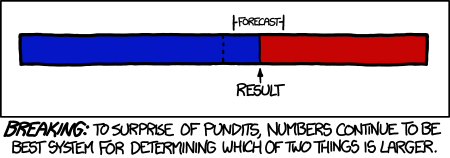
So, I am sure that Mr. B was pleased that math was one of big winners in last week's election, according to Smithsonian Magazine's Smart News blog:
"New Yorker reporter Ryan Lizza said this morning that after months of campaigning, the result of the 2012 election “was a huge victory yesterday for math.” Wired called 2012 “the nerdiest election in the history of the American Republic.”'How many times does a comic referencing math go viral? This one from the online comic site XKCD, did (it was mentioned in the above story):
Monday, November 5, 2012
Uncorked
It's November. Halloween has passed, we've turned the clocks back and daylight hours are fading fast.
In other words, it's that time when a business owner's thoughts turn to planning. Our TAB members are working on securing this year's successes and focused on defining their priorities for 2013. Happily, most of our businesses have seen gains this year, as is the case with many owners who are part of a knowledge-sharing group.
While each business plans in a way that is unique to it, I have found that the ones that are most successful in achieving their goals share some common approaches: they focus on fewer, but very specific goals; they set hard targets and timelines; and they lead their organizations to the achievement of the goals without doing the work themselves.
When leading planning discussions, I like to start with three baseline questions:
In other words, it's that time when a business owner's thoughts turn to planning. Our TAB members are working on securing this year's successes and focused on defining their priorities for 2013. Happily, most of our businesses have seen gains this year, as is the case with many owners who are part of a knowledge-sharing group.While each business plans in a way that is unique to it, I have found that the ones that are most successful in achieving their goals share some common approaches: they focus on fewer, but very specific goals; they set hard targets and timelines; and they lead their organizations to the achievement of the goals without doing the work themselves.
When leading planning discussions, I like to start with three baseline questions:
- What are your three priorities for 2013?
- What resources do you need to achieve them?
- What do you need to stop doing to make them happen?
Monday, October 29, 2012
Trying times
"I'll try."
Can you think of a more maddening phrase in business and in life?
While there are contenders -- such as "I think not;" "I could be wrong;" "just give me a while to think about it;" and "perhaps we should get the group together to discuss" -- to me "I'll try" is the biggest hedge in the human lexicon. If you are on the receiving end of an "I'll try," does it inspire confidence in a positive outcome? While I don't usually put much stock in the quotes of imaginary movie characters, Jedi master Yoda nailed it in "The Empire Strikes Back": "Do or Do not. There is no try."
Business owners are an optimistic lot, generally. They have to be to continue moving forward in their businesses in the face of continuing changes in customer preferences, competition, regulation, employee attitudes, etc.
The only constant in business, a CEO said at a recent TAB board meeting, is change, and "change drives growth."
Monday, October 22, 2012
Hear, say.
At a gathering of business folks recently, we discussed the book Power Questions. Those gathered found it to be a good, thought-provoking read, and some had already put some of the concepts and questions into practice in their organizations.

The author, Andrew Sobel, has penned several books on selling and fostering lasting client relationships. Good questions, in his words, "light fires under people, help them see problems in new ways, and inspire them to bare their souls. The result is deep personal engagement." Power Questions offers many great examples of great questions to ask and how to ask them, and provides the reader with more than 300 questions, grouped topically. It's a great resource for any business leader.
Is questioning enough, though? Most modern sales "systems" are now built around the concept of questioning, of "finding the pain" of the prospective buyer. Asking pre-programmed questions that are designed to manipulate the emotions of someone you just met doesn't seem like the recipe for success to me. As one of the members of our book group said, "if a salesperson asks me 'what keeps you up at night?', I know they are a hack and haven't done their homework."

The author, Andrew Sobel, has penned several books on selling and fostering lasting client relationships. Good questions, in his words, "light fires under people, help them see problems in new ways, and inspire them to bare their souls. The result is deep personal engagement." Power Questions offers many great examples of great questions to ask and how to ask them, and provides the reader with more than 300 questions, grouped topically. It's a great resource for any business leader.
Is questioning enough, though? Most modern sales "systems" are now built around the concept of questioning, of "finding the pain" of the prospective buyer. Asking pre-programmed questions that are designed to manipulate the emotions of someone you just met doesn't seem like the recipe for success to me. As one of the members of our book group said, "if a salesperson asks me 'what keeps you up at night?', I know they are a hack and haven't done their homework."
Monday, October 15, 2012
Higher hire
With unemployment being what it is in this country -- high, improving only gradually and with many more job seekers than available jobs, you'd think that employers would have the pick of the litter.
It ain't necessarily so. Or so it seems.
Business owners with whom I meet or work who have jobs to fill are decrying the lack of qualified applicants for those positions. The constant refrain that I hear is, "No one wants to work anymore," or some variation on that theme. There is certainly some be truth to that, but as the saying goes: "If you say you can't, then you won't."
There is always talent out there. Lots of talent. Gobs of it. It may seem counter-intuitive, but in this employment economy, you have to compete for talent if you want to hire more than mediocrity.
It ain't necessarily so. Or so it seems.
Business owners with whom I meet or work who have jobs to fill are decrying the lack of qualified applicants for those positions. The constant refrain that I hear is, "No one wants to work anymore," or some variation on that theme. There is certainly some be truth to that, but as the saying goes: "If you say you can't, then you won't."
There is always talent out there. Lots of talent. Gobs of it. It may seem counter-intuitive, but in this employment economy, you have to compete for talent if you want to hire more than mediocrity.
Monday, October 8, 2012
Out of the bowl*
Congratulations.
Your business is finally back on a growth track, after several years of struggle. Sales are not only improving, they are accelerating. Some hiccups month-to-month, but the trend line is steepening and extending.
Your increased profits have allowed you to finally move ahead and expand the range of products and services you offer. Your customers are reacting happily, buying more often and spending more per transaction. It's a virtuous circle.
Employees are happy. They are getting profit sharing bonuses and those bonuses are increasing as the business performs. You've installed the systems and processes to give them the autonomy to do their jobs without being micromanaged. You trust their judgment -- you have to, because you're now so large that you couldn't do their jobs even if you wanted to. In fact, there's several people you didn't hire yourself; your managers did.
Monday, October 1, 2012
Shooting for the moon...
1. easy to understand, deal with, use, etc.: a simple matter; simple tools.
2. not elaborate or artificial; plain: a simple style.
3. not ornate or luxurious; unadorned: a simple gown.
4. unaffected; unassuming; modest: a simple manner.
5. not complicated: a simple design
What happened to simple? Why has simple become so difficult?
By simple I mean "easy to understand and deal with," as noted above. Do you feel that your life -- business or personal -- is getting simpler: easier to understand or less complex? Bully for you if you do; you are in the minority.
But you know what? It's been ever so. Search for "simplicity quotes" and you''ll see exhortations, lamentations and admonitions going back centuries, even to the days of Leonardo da Vinci: "Simplicity is the ultimate sophistication."
Simplicity doesn't mean not difficult, not challenging. Consider JFK's famous challenge to the nation:
"I believe that this nation should commit itself to achieving the goal, before this decade is out, of landing a man on the moon and returning him safely to the earth."Simple goal, no? Devilishly difficult to execute? Absolutely, even with the unlimited resources of the government backing it.
Subscribe to:
Posts (Atom)