Showing posts with label growth strategies. Show all posts

Monday, April 1, 2013

Hop and change

Ah, Spring!

The sun has passed the equator, heading north, and the arrival of robins, crocus, matzoh and Cadbury eggs heralds the season of metaphoric and symbolic renewal.

More tangibly, one of the advantages of the return of light and warmth is getting outside to play.  The benefits of outdoor play are manifest.  It helps develop creativity, problem-solving ability and social skills that carry from childhood into adult work-life interactions in ways that indoor activities do not.

Take the game of hopscotch, for example.  It is an early childhood game of which I'm sure most of you are familiar.  According to research, there's a tremendous connection between this simple game and physical and cognitive development:
"...as your child refines her physical coordination, she is also building essential neural pathways in the brain. It's those exact same pathways which will one day become the conduits for left/right brain thinking tasks such as creativity, reasoning, and self-regulation."
In other words, it's not play, it's training.  And it carries on to the professional level.

And as Spring represents the return of growth cycle, hopefully your thoughts are turning to your employee playtime training.  Ongoing training is essential to growth, even for the smallest of businesses.  If your organization is going to grow, you have to grow everyone involved with it.  And that takes training.

Monday, March 18, 2013

Would you believe?

Do you thrive on order or disorder? Into Ccontrol or Kaos chaos?

Are you a connect-the-dots kind of manager, taking comfort in plans and processes, trusting in systems that provide structure to move your organization forward step-by-step?

Or do you prefer a more freewheeling environment, believing that adaptability and improvisation is a litmus test that allows one's mettle to come shining through.

It's probably not a question that business owners ponder very often, but it came up in conversation a number of times this week, speaking with prospective TAB Board members about their approaches to managing their companies.

Some of those I met with professed to love the challenge of dealing with constant change, navigating a stormy environment and choosing the correct tack to keep forward progress going.  Others, well, not so much. They preferred a more grounded and gradual approach.

I'm sure you know successful executives in both camps. Today's entrepreneurial zeitgeist certainly reflects more of the swashbuckling, freewheeling, disruptive business type. And, while the it may be a more sexy story, would you believe that this approach yields worse outcomes than the old-school methodical, follow-the-plan approach?


As Jim Collins illustrated in his book Great By Choice, a discipline he calls "20-Mile March" behavior is a leadership trait that gives organizations "the ability to impose order upon disorder, consistency amid swirling controversy" but only when it is combined with a near obsessive focus on making continued progress against the objective.

According to Collins:
"Some people believe that a world characterized by radical change and disruptive forces no longer favors those who engage in consistent 20-Mile Marching. Yet the great irony is that when we examined just this type of out-of-control, fast-paced environment, we found that every (successful) company -- unlike their less-successful peers -- exemplified the 20-Mile March principle during the era we studied."
Collins relays the expeditions of Roald Amundsen and Robert Scott, two well-matched teams racing for the South Pole.
"For one team, it would be a race to victory and a safe return home. For the second team, it would be a devastating defeat, reaching the Pole only to find the wind-whipped flags of their rivals planted 34 days earlier, followed by a race for their lives -- a race that they lost in the end.... One leader led his team to victory and safety. The other led his team to defeat and death....What separated these two men? Why did one achieve spectacular success in such an extreme set of conditions, while the other failed even to survive?"
Find Collins' answer here.

The difference between success and failure is often small, with progress sometimes barely measurable and perceptible only in hindsight. Most often it is the result of a series of incremental actions and decisions rather than any single event.  Having a well-drawn plan, combined with the temperament and leadership skills to implement it consistently, even in the face of adversity, gives your organization a demonstrable edge over more flamboyant but less dependable competition.

Missing by that much may make for comedic gold, but it is often not so amusing in life or in business.  Believe it.

Monday, March 11, 2013

The stuff of dreams?

My cousin is married to a musician of some note in certain musical circles. A blues and R&B bassist, "Choppy" performs with several bands and we try and catch him at his local shows whenever we can.  This past weekend, he and friends played a gig in Hudson.

One of their pieces was a raucous, bluesy cover of the country standard "16 Tons" that segued into the Eurythmics' techno-pop hit "Sweet Dreams (Are Made of This)," that they stripped down and rocked out.  They synthesized two seemingly discordant musical styles and schools into a jam that brought the house down.  Smartly, the bartenders chose this moment to pass around the tip hat.  Naturally, this got me thinking about finances.  Small business finances, specifically.

I have met with several business owners lately who have not taken advantage of opportunities that would accelerate their growth.   They each had reasons:  uncomfortable funding the investment from their equity, uneasy about diminishing their cash flow, unwilling to take on debt.  It made me wonder, have even entrepreneurs become too risk-averse when it comes to employing all options for financing growth?


In the aftermath of the financial crisis that began in 2007, debt has become a figurative four-letter word (it already was a literal one.)  There's no argument that we had a debt binge in this country (globally, actually) and that our economic challenges are attributable in large part to postponing working through the necessary deleveraging process.

As marketer Seth Godin once noted:  The guy who invented ships also invented shipwrecks.  Thankfully, the perils of sailing did not scuttle seafaring.  Has the pain of the debt bubble created a mindset that is too limiting where debt financing is concerned? 

Access to debt financing can be a powerful force for small business growth.  It has ever been thus.  It is called leverage for a reason:  small amounts can have a powerful effect.  If you've kept good books, are profitable with a history of good cash flows (and have good credit score), banks and community lending institutions will and want to lend to you. 

Capital is the essential lubricant of commerce and for small businesses it is practically the elixir of life. Yet some now view debt as if it were unicorn blood, extracting a terrible toll for its employ. Smoothing out the cyclicity of cash flows rather than being hamstrung by them is smart financial management.  And the right debt can often be cheaper and provide more operating flexibility than equity capital.

Tennessee Ernie Ford may have lamented debt "to the company store" as an unholy burden, but for smart business owners, it is the stuff of which sweet dreams can be made.


      Monday, February 25, 2013

      Swing and a...

      Baseball's spring training has commenced.  I know this by the calendar, and by the fact that I've been hearing baseball cliches more frequently in recent business meetings.

      "I've told my people that I want them to be more aggressive.  Have a plan and swing the bat," one CEO told me recently. "It's OK for them to strike out, but I want them swinging."

      This statement brought to mind the 2006 National League Championship Series (NLCS), when NY Mets outfielder Carlos Beltran was at the plate in a situation that many who play baseball dream about:  deciding game, bases loaded, two outs and the winning run on base.

      Monday, January 28, 2013

      Going for it

      In baseball, there's a saying, "You can't hit a five run homer."  It's an admonition to players that a deficit has to be overcome one batter at a time, and to focus in the moment, rather than project forward.  Contribute your part; let the next guy do his.  Some call it "small ball." Or deride it as incrementalism. One of the most memorable moments in American sports was built on such small steps. (Relax, Red Sox Nation, you had your moment.)

      The debate over "big play" versus "march down the field" has raged for eons...in and out of sporting arenas.  Think tortoise v. hare, a fable from Aesop and ancient Greece.

      It's true that sluggers are traditionally more revered by fans and big-armed quarterbacks capture more imagination than a great cover corner back.  We have home run derbies at the All Star game, not doubles up the gap contests.

      But do the bombers win more?  Do they contribute more to success than well-rounded excellence?  Not according to some.  The book and film Moneyball, which is about management as much as it is about baseball, is a recent contributor to this debate.  In the world of big business, the go-for-broke and grind-it-out camps each have visible success stories.

      Monday, January 21, 2013

      Is grease the word?

      "I hate to be a kicker,
      I always long for peace,
      But the wheel that does the squeaking,
      Is the one that gets the grease."
       -- Josh Billings, "The Kicker," ca. 1870

      I'm sure that most of you are familiar with the "squeaky wheel" adage, the origin of which is credited to the poem above. Josh Billings was a 19th century American humorist, second in popularity in his time only to Mark Twain.

      For business owners, the Squeaky Wheel syndrome is no laughing matter.  You want happy customers, not disgruntled ones. Organizations go great lengths and invest great sums to ensure that their organizations not only understand best practices but execute them flawlessly.  Some succeed, some don't: There are both customer service Halls of Fame and Halls of Shame

      In a recent discussion about the book Raving Fans, a bestseller about how to make great service a competitive advantage, business owners discussed how they instilled and practiced the "customer first" mentality in their companies.


      One retailer described how he sends notes and small gifts to customers who have had issues, whether real or imagined.  Asked if she did this for all unhappy customers, she replied "no," but more often than not.  Then she was asked what she sends her "best" customers...the ones who buy most frequently, spend the most, are most active on the company's social media pages.  After some uncomfortable, but thoughtful silence, the answer was, "nothing, but that will now change." 

      Squeaky wheels surely need attention.  But make sure that the silent wheels, the ones carrying the load for your business without issue or complaint, are well cared for and properly maintained.  You may not always hear them, but you'll notice them when they are gone.  And you'll save on grease, which is literally and metaphorically both messy and expensive.

      Monday, January 14, 2013

      On the edge

      I attended a terrific seminar last week, hosted by a local professional association about which I had heard many good things.  As with many first-of-the-year meetings, the topic was planning for business generation.  The room was overflowing.

      The presenter did an excellent job of building participation and conversation:  she didn't talk at the audience, but rather made a few points that led to interaction among the participants...sharing of information...making of connections, etc.  Attendees left the meeting animated and motivated.  Who could ask for more for on a January Friday afternoon?

      There was one statement that the presenter made as she exhorted the crowd to develop personal marketing plans that was a lone discordant note in a otherwise resonant and well-orchestrated presentation:
      "Your mother and grandmother were wrong: Humble does not work."
      Is that true?  The antonyms of humble include arrogant, chesty, self-important, beaming, swelled, vainglorious, big-headed, persnickety, snooty, snot-nosed, stuck-up, too big for one's breeches, boastful and braggart.  I don't think those qualities are what the presenter would recommend as keys to winning friends and influencing people.  Unless you're running for Congress.

      Business professionals today face a conundrum.  There is no question that while the ability to connect is growing exponentially, it is also harder to gain visibility and capture attention.  So we're resorting to stunts, gimmicks, the outsized and the outlandish and labeling it "edgy" to rationalize our actions.

      Monday, November 12, 2012

      By the numbers


      "In the end, it should always come down to the maths."  That was the wisdom of my sixth grade teacher, Mr. Balsam, who spoke about mathematics the way the Brits do -- calling it maths instead of math.  (He taught there for a couple of years in the 60's, before coming back to the colonies.)

      The point he was making is that a facility with numbers is essential to proper decision making, by providing an orderly and logical underpinning for sifting through the information that bombards us.

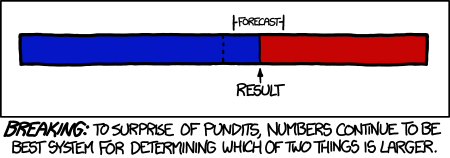
      So, I am sure that Mr. B was pleased that math was one of big winners in last week's election, according to Smithsonian Magazine's Smart News blog:
      "New Yorker reporter Ryan Lizza said this morning that after months of campaigning, the result of the 2012 election “was a huge victory yesterday for math.” Wired called 2012 “the nerdiest election in the history of the American Republic.”'
      How many times does a comic referencing math go viral?  This one from the online comic site XKCD, did (it was mentioned in the above story):


      Monday, June 25, 2012

      Main Street, with a bullet

      The phrase "with a bullet" derives from the music industry.  It comes from Billboard magazine, the recording industry's bible in the age before digital downloads, iPods, piracy and business model implosion.  The term means a rapid ascension on a list...in the case of music, "climbing the charts."

      "Small business" is number two with a bullet -- up 42 points --  according to Gallup's new study on Americans' confidence in major institutions.  Small business trails only the military in the level of trust the US citizenry places in it, followed by the police and religion.  (Interesting cocktail chatter the members of those groups would share.)

      Big business, HMOs and Congress top the he bottom of the list.  I'm sure you're shocked, shocked.

      Friday, June 1, 2012

      So sell me.

      Last in a series...

      The world of commerce has changed dramatically in the past few years. Technological, demographic, social and economic changes are raining over small businesses like a never ending series of squalls.

      The processes and techniques employed by many small businesses were developed in the mid-to late-20th century and built for a “broadcast” world that for the most part no longer exists: large audiences that you can reach and motivate through traditional, one-way “tell and sell” laden with cliches and jargon.

      Monday, May 21, 2012

      Who are you?

      Third in a series...

      In 1978, The Who asked the musical question, "Who are You?" While the song and album were an exploration of conflicting progressive and punk rock attitudes, nearly 35 years later their query could be the anthem for current sales and marketing angst.

      Gathering meaningful information on customers is one of the most important tasks for small businesses.  It is also one of the most difficult, and therefore, among the most neglected by small business owners. 

      At its most basic level, any operating business has two target audiences:  current customers and potential customers.  Most proprietors I meet and/or work with operate under a "build it and they will come" approach of one form or another.  And for most, it works well in getting a business through its formative stages:  establishing a customer base and following, and building a revenue stream.

      But to scale an enterprise takes more focus.  After all, your target market is not everyone.

      Saturday, April 21, 2012

      Is it safe?

      Growth is always a hot topic at the monthly TAB meetings I facilitate:  strategies, plans, tactics, obstacles, wins, losses, etc.

      Most of our businesses are doing well, but some have seen their top lines flatten and a very few have experienced sales declines.

      Bottom line-wise, our business owners have seen their operating costs escalate.  The cost of goods, taxes, health care, energy, professional services have all been rising. Most have been very good at maintaining their margins by controlling their variable expenses.

      But nipping and tucking only gets you so far, as we are finding out in the debate over growth versus austerity at the national and international level.  You can't cut your way to growth over the long term.

      Saturday, March 31, 2012

      Haircuts, Lipstick and Yogi

      -->
      One day recently I dashed into a local haircut shop shortly after it opened, hoping to beat the rush and get a quick trim before a meeting.  It had been a while and I was looking and feeling shaggy.

      The store is one of those national franchise chains that have grown, weed-like, to seemingly inhabit every local shopping center.  It has been hawking its franchises on CNBC, LinkedIn, and other media.

      There was no one in the store when I entered…no customers and no employees up front.  After a couple of minutes, a young woman (I'll call her Abby) came up from the back and apologized for my wait, saying, “it takes us a little longer to open up because we are short-staffed these days.” 

      My family and I patronize this store frequently.  The staff is attentive, friendly and professional.  The cost of its services are reasonable, the cuts competent and the customer loyalty program keeps us, well, loyal.  The store has been popular and can get crowded at peak times, hence my early morning visit.

      Saturday, March 24, 2012

      Information duncity

      Did you ever notice how some memes seemingly appear out of nowhere, then are suddenly ubiquitous -- like the car you never noticed until you bought one and now it seems everyone owns one?

      I recently wrote about how failure can actually lead to success, and how "one's errors are a portals of discovery."  Turns out lots of people are talking and writing about mistakes lately.

      One of the best pieces I've seen is one from TAB colleague John Dini, who recently wrote on the value of mistakes in business. His advice to start a "mistake budget" is one that I will steal gratefully, with generous attribution.

      However, mistakes aren't always all they are cracked up to be.  In this unforgiving economy, we need to maximize "good" mistakes and minimize the "bad" ones.  We need to make better decisions.

      And there's the rub.

      Friday, March 2, 2012

      Land of the free

      -->
      So, how did you spend your free day on Wednesday?  You, know, February 29, aka Leap Day.

      Ladies, did you channel your inner Sadie Hawkins?

      Dudes, did you take it head on, mano-a-mano.

      Was it a day of routines, deadlines, accomplishments, chores, sports, striving.  Just another day; one of 365 366? 

      Pity if you didn't leverage this quadrennial opportunity. 

      It was FREE.  What do you mean that  you didn't take advantage of it?  What's wrong with you?  Don't you love free stuff?  Doesn't everybody?  Didn't you get the memo?

      It seems that there's a offer of "free" everywhere you look:  Buy One/Get One Free; Free Estimates; Free Consultation; Free Delivery.  Consumers lap it up.  And why not, it's FREEEE!

      No wonder the country is broke.  We're giving it all away.  Increasingly so.  Hard to make a buck that way, isn't it?

      Saturday, February 25, 2012

      Failures and other success stories

      -->
      It took Thomas Edison ten thousand tries to perfect the light bulb.  It’s a, if not the, classic story of overcoming failure through perseverance.

      But the reality is that the founder of GE had resources unavailable to most private business owners today.  It begs the question:  how many failures can you afford before you get it right?  Certainly, it's far less than old Tom.

      Failures are part of business, and life.  If we are smart, we learn from them. If we are not, we are soon out of business, and sometimes out of life

      But let's not dwell on the negative.   There are plenty of motivational and instructional quotes on the value of trying but failing, one of my favorites being "A man's errors are the portals of discovery."

      If failures are inevitable, can we minimize their occurrence and impact on our businesses and our lives?  How do we turn them into teachable moments, into Joyce's "portals of discovery?"


      Monday, February 6, 2012

      Going for broke?

      Last night's Super Bowl was a thrilling one:  tightly-played between evenly-matched teams.  It came down to the last second,  a desperation heave -- a "Hail Mary" -- hoping to turn defeat into victory.  Didn't happen...for the Patriots, anyway.

      But as the coach said after the game, there were "100 plays" that he'd like to do over again.  He wasn't so much talking about the strategy or design of any of the plays, but the execution.  After six months of practice and playing, it came down to the last minute and a couple of plays that didn't work out quite as planned.  Any of them could have changed the outcome.


      Stuff happens, as they say...all the time.  In football, in business and in life.

      But while there are many parallels and analogies between football and life, as a business owner or leader, if you are in in the position the Patriots were in with just over a minute left in the game, it is a classic Catch-22 if ever there was one.

      In business, if you need to go for broke, the likelihood is that you already are well on your way to getting there.  If you are between a rock and a hard place, it is a much different reality than a football game where everyone goes home a bit richer.  


      Monday, January 23, 2012

      Ode to the vision thing


      Ok, not really an ode, at least in the English tradition. More a lamentation.

      It's been 25 years since the "vision thing" died at the hands lips of the first President Bush.  That phrase, according to Wikipedia, has now become a metonym for an inability to articulate the bigger picture.

      A few years later, Lou Gerstner, then recently-installed CEO of a then-troubled IBM, was famously quoted as saying: "the last thing IBM needs right now is a vision."

      What is it with vision that evokes such a roll of the eyes and shaking of heads among many leaders, business owners, CEOs and other organizational chiefs?

      For many, having a vision recalls images of being lost in the desert, returning with a call to action from some higher authority.  For others, it may conjure images of the Summer of Love.  No business strategies emanate from either of those retreats.  No increased sales or profits, either.

      So then, is myopia a virtue for a leader?  Not really, as target fixation often leads to missing the bigger picture.

      Let's turn again to Gerstner, and examine his full "vision" quote, delivered at a news conference following his first 100 days at Big Blue:
      ‘There’s been a  lot of speculation as to when I’m going to deliver a vision of IBM, and what I’d like to say to all of you is that the last thing IBM needs right now is a vision [. . . ] What IBM needs right now is a series of very tough-minded, market driven, highly effective strategies for each of its businesses – strategies that deliver performance in the marketplace and shareholder value."
      Later, Gerstner wrote in IBM's 1993 Annual Report, "Some call it mission, some call it vision. I call it strategy."  Few would argue that Gerstner's vision/mission/strategy focused IBM on a successful path forward, when many other US commercial icons have failed to make the turn


      Thursday, January 5, 2012

      Shark Jumping

      It's a new year, and the armchair quarterbacking on 2011 is in full swing, as a variety of businesses, mostly retail, report December results.  It looks like a mixed bag...some gainers, some laggards, some BIG losers.

      Sears and Kmart seem to be among the losers, with the announcement that they will be shuttering stores across the country.  Will we lose these venerable names to the dustbin of business history?  Possibly, and they would join a decidedly non-illustrious group.

      While attention is paid on the failure rate of small and start-up businesses, as noted in this recent blog post, there is also a continuing churn at the top of the corporate heap:
      Comparing the Fortune 500 companies in 1955 and 2011, there are only 67 companies that appear in both lists. In other words, only 13.4% of the Fortune 500 companies in 1955 were still on the list 56 years later in 2011, and almost 87% of the companies have either gone bankrupt, merged, gone private, or still exist but have fallen from the top Fortune 500 companies (ranked by gross revenue). Most of the companies on the list in 1955 are unrecognizable, forgotten companies today.  That's a lot of churning and creative destruction, and it's probably safe to say that many of today's Fortune 500 companies will be replaced by new companies in new industries over the next 56 years.

      Along with Sears and Kmart, Best Buy seems to be jumping the shark as well. This Forbes story tells a tale that is all too familiar to customers, but seems to continually escape notice of those leading these sinking ships.  In nearly all cases, the operators lose touch with the customers...and start selling what they want, rather than what the customer wants or needs.

      Smaller business owners have a natural advantage over these behemoths, in that they are closer to their customers, but, alas, often suffer the same "buy what I have" rather than "sell what you want" mentality.

      It's the customer who decides your businesses fate.  Engaging yours in an active dialog about their wants and needs is the single best thing you can do to grow your business.


      Saturday, December 17, 2011

      The enemy: Embrace or dispatch?

      Competition and Competitors.  It's been a topic of conversation at our TAB Board meetings in recent weeks.

      While there are as many different views on the subject as Baskin-Robbins has flavors, they often settle into two main camps:  friend or foe.

      Here are two favorite quotes that sum up those competitive mind-sets:
      • "I will destroy my enemies by converting them to friends." - Maimonides
      • “Every normal man must be tempted at times to spit on his hands, hoist the black flag, and begin to slit throats.” - H.L. Mencken.

      In reality, it's a little less sinner or saint.  Most of us belong to trade associations or professional groups where fraternization is not only encouraged, but mandated.  Many of us also get work or referrals from within our industry, often from competitors.  "Coopetition" has become a standard business practice.  And if you have a sale as the exit plan for your business, your most likely buyer is a competitor.

      One of the legends of the industry I grew up in had a standard practice of lunching with his competitors on a regular basis...he figured there was enough business for all, and that each of the firms were struggling with the exact same issues.  As a result, he built not only a business, but a legacy.

      How do you deal with your competitors?  Do you treat them as the enemy, view them as irrelevant, tap their brains for knowledge, keep them at arms-length?

      Do you keep to the advice of Don Corleone?  Or do you have a Blue Ocean Strategy approach?

      Today's competitor may be tomorrow's client, or your next CEO.  In an ever-more networked, inter-connected and constantly-evolving business economy (especially in a local or regional commercial ecosystem), strategic cooperation can maximize value in a way that a winner-take-all mentality cannot. 

      Besides, spitting isn't hygienic.