Monday, November 26, 2012

The half of it

There are probably not many who don't know the old adage about the half-filled glass: that the optimist sees the glass as half-full, while the pessimist views it as half-empty.


That aphorism has been extended in many ways: An economist would say that, adjusted for inflation, the glass is 10% less full than two years ago; a banker would say that the glass has 50% of its net worth in liquid assets; politicians would say that it would be fuller if you vote for their programs, and a private equity investor would say that they could get rid of the excess glass, then fill it back with a bit of leverage.

And finally, some would over think it altogether.

In the days leading up to the Thanksgiving break, there was much to-and-fro about the state of the world:  the results of the election, the fiscal cliff, a world without Twinkies, Black Friday, Small Business Saturday, etc., etc., ad nauseum.

While those of us who prefer not to live in caves or with our heads in the sand have more than a passing interest in the news of the day, fixating on macro issues is mostly a distraction, and finding the truth is as elusive as ever.

Monday, November 19, 2012

School's in

Discussions at our monthly TAB Board meetings are usually both deep and wide-ranging, as you might expect from a gathering of business owners and CEOs who've come to "talk shop."

From initiatives to ideas to strategies for implementing same, the conversations can get intense.  Board members are focused on improving their operations and their ability to manage the constant change that comes from that striving.  As my colleague John Dini wrote this week, while failure may indeed be an option, in order to succeed, good enough never is.

Or as C.S. Lewis said:  "Experience is a brutal teacher.  But you learn.  My God, do you learn." 

Some lessons from the field, from the mouths of CEOs:
  • Follow the money: When analyzing sales results, "Follow the money."  Poor closing rates usually mean an inability to ask for the sale (the money) or to get to the decision maker (the money.) Find out which it is and coach to correct.  Or find someone who wants to follow the money.
  • Focus on focus: When assigning new initiatives or tasks, always ask two questions: "What do you need to perform this and what do I need to take away?"  This helps focus yourself and your staff on the resources and commitments needed to execute the task and also generates buy-in.  Both are critical to successful delegation.

Monday, November 12, 2012

By the numbers


"In the end, it should always come down to the maths."  That was the wisdom of my sixth grade teacher, Mr. Balsam, who spoke about mathematics the way the Brits do -- calling it maths instead of math.  (He taught there for a couple of years in the 60's, before coming back to the colonies.)

The point he was making is that a facility with numbers is essential to proper decision making, by providing an orderly and logical underpinning for sifting through the information that bombards us.

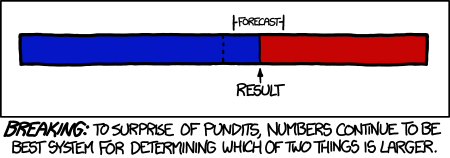
So, I am sure that Mr. B was pleased that math was one of big winners in last week's election, according to Smithsonian Magazine's Smart News blog:
"New Yorker reporter Ryan Lizza said this morning that after months of campaigning, the result of the 2012 election “was a huge victory yesterday for math.” Wired called 2012 “the nerdiest election in the history of the American Republic.”'
How many times does a comic referencing math go viral?  This one from the online comic site XKCD, did (it was mentioned in the above story):


Monday, November 5, 2012

Uncorked

It's November. Halloween has passed, we've turned the clocks back and daylight hours are fading fast.

In other words, it's that time when a business owner's thoughts turn to planning.  Our TAB members are working on securing this year's successes and focused on defining their priorities for 2013.  Happily, most of our businesses have seen gains this year, as is the case with many owners who are part of a knowledge-sharing group.

While each business plans in a way that is unique to it, I have found that the ones that are most successful in achieving their goals share some common approaches:  they focus on fewer, but very specific goals; they set hard targets and timelines; and they lead their organizations to the achievement of the goals without doing the work themselves.

When leading planning discussions, I like to start with three baseline questions:
  • What are your three priorities for 2013?
  • What resources do you need to achieve them?
  • What do you need to stop doing to make them happen?

Monday, October 29, 2012

Trying times


"I'll try."

Can you think of a more maddening phrase in business and in life?

While there are contenders -- such as "I think not;" "I could be wrong;" "just give me a while to think about it;" and "perhaps we should get the group together to discuss" -- to me "I'll try" is the biggest hedge in the human lexicon.  If you are on the receiving end of an "I'll try," does it inspire confidence in a positive outcome?   

While I don't usually put much stock in the quotes of imaginary movie characters, Jedi master Yoda nailed it in "The Empire Strikes Back":  "Do or Do not.  There is no try."

Business owners are an optimistic lot, generally.  They have to be to continue moving forward in their businesses in the face of continuing changes in customer preferences, competition, regulation, employee attitudes, etc.

The only constant in business, a CEO said at a recent TAB board meeting, is change, and "change drives growth."

Monday, October 22, 2012

Hear, say.

At a gathering of business folks recently, we discussed the book Power Questions.  Those gathered found it to be a good, thought-provoking read, and some had already put some of the concepts and questions into practice in their organizations.

The author, Andrew Sobel, has penned several books on selling and fostering lasting client relationships.  Good questions, in his words, "light fires under people, help them see problems in new ways, and inspire them to bare their souls. The result is deep personal engagement." Power Questions offers many great examples of great questions to ask and how to ask them, and provides the reader with more than 300 questions, grouped topically.  It's a great resource for any business leader.

Is questioning enough, though?  Most modern sales "systems" are now built around the concept of questioning, of "finding the pain" of the prospective buyer.   Asking pre-programmed questions that are designed to manipulate the emotions of someone you just met doesn't seem like the recipe for success to me.  As one of the members of our book group said, "if a salesperson asks me 'what keeps you up at night?', I know they are a hack and haven't done their homework."

Monday, October 15, 2012

Higher hire

With unemployment being what it is in this country -- high, improving only gradually and with many more job seekers than available jobs, you'd think that employers would have the pick of the litter.

It ain't necessarily so. Or so it seems.

Business owners with whom I meet or work who have jobs to fill are decrying the lack of qualified applicants for those positions.   The constant refrain that I hear is, "No one wants to work anymore," or some variation on that theme.  There is certainly some be truth to that, but as the saying goes: "If you say you can't, then you won't."

There is always talent out there.  Lots of talent. Gobs of it.  It may seem counter-intuitive, but in this employment economy, you have to compete for talent if you want to hire more than mediocrity. 

Monday, October 8, 2012

Out of the bowl*


Congratulations.

Your business is finally back on a growth track, after several years of struggle.  Sales are not only improving, they are accelerating.  Some hiccups month-to-month, but the trend line is steepening and extending.

Your increased profits have allowed you to finally move ahead and expand the range of products and services you offer.  Your customers are reacting happily, buying more often and spending more per transaction.  It's a virtuous circle.

Employees are happy.  They are getting profit sharing bonuses and those bonuses are increasing as the business performs.  You've installed the systems and processes to give them the autonomy to do their jobs without being micromanaged.  You trust their judgment -- you have to, because you're now so large that you couldn't do their jobs even if you wanted to.  In fact, there's several people you didn't hire yourself; your managers did.

Monday, October 1, 2012

Shooting for the moon...

Sim·ple [sim-puhl]  adjective, sim·pler, sim·plest, noun adjective

1. easy to understand, deal with, use, etc.: a simple matter; simple tools.
2. not elaborate or artificial; plain: a simple style.
3. not ornate or luxurious; unadorned: a simple gown.
4. unaffected; unassuming; modest: a simple manner.
5. not complicated: a simple design

What happened to simple?  Why has simple become so difficult?

By simple I mean "easy to understand and deal with," as noted above.  Do you feel that your life -- business or personal -- is getting simpler:  easier to understand or less complex?  Bully for you if you do; you are in the minority.

But you know what?  It's been ever so.  Search for "simplicity quotes" and you''ll see exhortations, lamentations and admonitions going back centuries, even to the days of Leonardo da Vinci:  "Simplicity is the ultimate sophistication."

Simplicity doesn't mean not difficult, not challenging.  Consider JFK's famous challenge to the nation:
 "I believe that this nation should commit itself to achieving the goal, before this decade is out, of landing a man on the moon and returning him safely to the earth."
Simple goal, no?  Devilishly difficult to execute? Absolutely, even with the unlimited resources of the government backing it.


Monday, September 24, 2012

Your aim, please?

"In the long run, men only hit what they aim at."- Henry David Thoreau.


I bet you didn't think of old Hank Thoreau as a management guru.  Perhaps you know him better as  "author, poet, philosopher, abolitionist, naturalist, tax resister, development critic, surveyor, historian, and leading transcendentalist."

The sentiment above is a nice thought on focus. And that's how the quote is often used, including by yours truly.  We love focus.  Focus is important; you can't hit your targets without being able to sight them.

But focus is only half the story and quote (literally.)  Thoreau's coda is "...therefore, though they should fail immediately, they had better aim at something high."

A romantic sentiment, beautifully expressed.  But is Thoreau's quote espousing a good business principle?  Is it the big picture that matters? Is vision is more important than accomplishment?

We've looked at the both the "vision thing" and "failure is the best path to success" before, and found a fixation on either, to the exclusion of the other, somewhat problematic.

Monday, September 17, 2012

Reach out

Summer officially ends at 10:49 am EDT this Saturday, September 22, if you want to mark your calendar and get your eggs ready.

As the calendar turns from the lazy, hazy days into the rush of school, sweaters and falling leaves, so to does business psychology...to the coming fourth quarter, the end of the calendar year, the literal and figurative accounting of the year's progress (or lack thereof.)

Perhaps that's why so many of my discussions this month have focused on sales and selling...business owners are taking another look at their numbers, their goals for this year and next and asking themselves, their staffs and their advisors "what's next?"  This cogitation is a good thing; the time to plan is now.

At one recent TAB Board meeting, one business owner -- whose sales come predominantly through manufacturing reps and distributors -- reported increased sales to this group following face-to-face visits by company scientists (the company has no salespeople, per se.)  The results were so striking that they have begun a program of formal visits to their reps around the world.  The next step is hiring a professional to manage distributor relations.

Personal attention, interpersonal relations, human dialogue -- such a concept, as my bubby would say. In our increasingly digital virtual world, up close and personal is becoming the exception, and not just in business or selling. 


Monday, September 10, 2012

Thine own self


"This above all: to thine own self be true,
And it must follow, as the night the day,
Thou canst not then be false to any man.
Farewell, my blessing season this in thee!"

- Polonius, Hamlet, Act 1, Scene 3.

The meaning of the words above, written 400 years ago, have been studied, debated and written about almost from the time they were penned.  Here's one take that I find satisfying:
By "false" Polonius seems to mean "disadvantageous" or "detrimental to your image"; by "true" he means "loyal to your own best interests." Take care of yourself first, he counsels, and that way you'll be in a position to take care of others.
For business owners, to be honest in your dealings with others is fairly intrinsic:  you won't get far in deceiving your business' stakeholders.

Take care of yourself first, now there's the rub.  As we have written about before, many business owners choose to do without, to sacrifice for the greater good of their businesses, often at their own expense.  Right or wrong, I don't know too many business owners who are in it solely for the money. 

Is that wise?  From a financial standpoint, no it is not.  As my colleague John Dini eloquently and correctly argues, businesses owners have a right to (all of the) profits.  Profits are a result, not a goal, however.

When financial considerations alone drive decisions, poor choices and outcomes often follow.

Monday, September 3, 2012

Gone fishing

I'm taking the holiday off.  Really...it's on our bucket list.

If you're jonesing, here are some blasts from the past, provided as a therapeutic service.
Enjoy over your morning Joe and then go play!

See you on September 10.

Monday, August 27, 2012

Bucket list

Before I headed off to a business conference last week, my 10-year-old son handed me a piece of paper with a half-dozen or so items written on it, in bulleted form.  The title of his list was "Six Things I Want to Do With Dad Before School Starts."

My first reaction -- before reading the list -- was to be impressed by his ability to organize his thinking in this fashion at his age.  I gave him a squeeze, and tucked it in my bag to read on the plane.

I got to it on the return flight home.  His note read:

"Dad, when you come back from Denver, there will be 10 days until school starts.  We haven't done a lot of the stuff you said you wanted to do together.  Here's the list for you.  I know we can do it."

He'd organized it by day, grouping activities together in well-thought-out, logical sequences.  Of course, not being proficient in Microsoft Outlook, he hadn't factored in my appointments for the week.

One of the lessons I learned on my trip last week was that to take on something new, we have to give up something -- to make space -- to have the capacity to fulfill our mission.

So, I took take care of the calendar myself.  Ben's been added.  Other things are being re-prioritized, re-scheduled and re-allocated, starting here.

S'more good stuff to come.  See you in September...


Monday, August 20, 2012

Breaking away

It's the back half of August.  Have you taken your summer vacation?

According to Wikipedia, vacation is a fairly modern invention, and has evolved over the past 200 years.  This makes sense, as it coincides with the rise of a modern industrialized economy.
"In the Puritan culture of early America, taking a break from work for reasons other than weekly observance of the Sabbath, was frowned upon. However, the modern concept of vacation was led by a later religious movement encouraging spiritual retreat and recreation. The notion of breaking from work periodically took root among the middle and working class."
The origins of the word date back to late 14th century France, meaning "freedom from obligations, leisure, release," and is derived from the Latin vacationem "leisure, a being free from duty," and vacare "be empty, free, or at leisure."

The operative word in the history of vacation is being "free."  Did you feel free during your interregnum?  Or were you worried about palace coups or other more mundane business concerns?  I know business owners who rarely take more than a long weekend, and I know others who take weeks off regularly, in addition to other time away from the business, and run successful, growing businesses.


Monday, August 13, 2012

Go Team!

In last week's post, I noted that the phrase "An Army of One" is an oxymoron for small business owners. As it turns out, the Army also apparently felt that it was antithetical to the ethos of teamwork, and phased the phrase out.

Ah, teamwork...who doesn't want a "team player?"  Businesses spend millions, if not billions, of dollars in pursuit of talented teammates.
  • We advertise for them in our recruitment ads (who wants to hire a boat-rocker?)
  • We read books about building good teams (millions of them)
  • We listen to motivational speeches by successful sports team coaches.

We spend much time and energy thinking about teams.  But it also seems that a similar amount of time is spent moaning about our recruits' lack of individual initiative and how to motivate them.  How do we square this circle?


Monday, August 6, 2012

Dead-eye

This week we mark two milestones:  the two-year anniversary of our TAB business and blog post number 50.

We will be celebrating the former with friends of TAB at our Summer Social, to thank them for their support of our enterprise.  Without you our journey would not have gotten much past the start, would not been nearly as fulfilling and surely would not have been as much fun.  We will all refrain, though, from expressing our inner Kool and the Gang.

As to this blog, over the past year we have tried to reflect that journey through our weekly posts, channeling the information, advice, trials and triumphs of our members and the organizations and individuals that make up our community.  It has been given me the ability to pay forward the education that I am continually receiving from the Capital Region business owners, leaders and entrepreneurs who are successfully leading their organizations forward.


Monday, July 30, 2012

Heading north?

"True north" was a wildly popular term in the late 20th century. So popular that dozens of companies, organizations and products incorporated the term into their name.  Paradoxically, it became so widely embraced and adopted that its usage in recent years has gone south

True North is, literally, a physical place.  It refers to the earth's geographic North Pole.  It is unmovable, immutable, constant, consistent.  It is, not literally, the polar opposite of Magnetic North, which varies in time and place, and by your perspective.

So, navigationally, literally and figuratively, it is best to know True North, or you may be traveling off course.

Metaphorically, it is also necessary to find and understand your True North if you wish to end up where you want to go metaphysically.


Monday, July 23, 2012

What's next?

Back when I was just beginning my climb up the corporate ladder, I had a boss who infuriated me.  We had little in common, except our employer.

I was young, confident, dedicated, eager to please and hungry to earn my stripes yesterday.  I was the proverbial young man in a hurry.  After all, I had joined the corporate world with a passel of collegiate achievements, a brain full of book-learning and ideas out the wazoo for how to do things differently and better.  Full of piss and vinegar, as they say.

He was ancient forty-something.  A West Pointer who had served in 'Nam.  He was a hard-ass and I was just a plebe.

Whenever I finished some project or assignment or report, he'd give a quick, cursory thank-you and then ask, "What's next?"  Every. Single. Time. 

I wanted a pat on the back, an acknowledgement of my brilliance, an atta-boy.  I wanted some show of gratitude for the contribution I thought I was making.  I wanted recognition.  After all, that was what I expected after being a BMOC.  Who did he think he was?

He would have none of it.  Peering over his readers, he'd ask "What's next," as if I had an actual clue as to what he was talking about.

He stifled me. I hated him.  I called him "Big Brother."


Monday, July 16, 2012

We, the leaders

Is business ethics an oxymoron such as "open secret,"act naturally" or "exact estimate?" Sure seems that way as the list of misdeeds grows.

The Libor scandal continues to gestate like that deadly virus from The Andromeda Strain.

(Even if you can't differentiate Libor from a Labradoodle, you should be paying attention as it affects pretty much everything in the world of commerce.)

Other recent transgressions include faked CEO resumes, bribery, and outright theft, to name a few.

While businesspeople acting badly is certainly not the norm, the lack of business ethics is not a new subject. The portrayal of businessmen (and women) as murderers, conspirators and villains is one that apparently never grows old.  The list of business-related morality-tale movies is long and notorious illustrious.

None of the business owners I coach or consult with are sociopaths, fortunately, and I think it is safe to say that more business owners are focused on doing good, as opposed to doing well. They're more likely to be Rotarians than recidivists.